

Table of Contents


Ready to create more pipeline?
Get a demo and discover why thousands of SDR and Sales teams trust LeadIQ to help them build pipeline confidently.

.png)

Healthy B2B sending stays under 2% bounce, but B2B contact data decays roughly 22.5% a year, meaning a list that was clean at capture won't stay clean while it sits unused.
83% of non-delivery traces back to sender reputation, not individual bad addresses, so a few stale emails in one sequence can damage deliverability for everything else you send.
Verifying an email once at capture time isn't enough. Re-verifying right before it syncs to your sales engagement platform, as LeadIQ now does automatically for Outreach, catches the decay that happens in between.
Get a demo and discover why thousands of SDR and Sales teams trust LeadIQ to help them build pipeline confidently.
You captured a list of verified contacts three weeks ago. You finally load them into a sequence today. A chunk of them bounce on the first send.
Nobody touched the list in between. Nobody made a mistake. The emails were accurate when you captured them, they weren't accurate anymore by the time you hit send.
This is the part of email deliverability that doesn't get talked about enough. Most teams treat bounce rate like a one-time data quality problem, something you fix by picking a better vendor or running a cleanup project twice a year. It's actually a timing problem, and it never stops.
Healthy B2B sending sits under 2% bounce rate across the board, with well-run outbound sitting closer to 0.7% to 1.5%. Cold campaigns, though, average 7.5%, which tells you something important: most teams are already sending well above the safe threshold, they just don't notice because deliverability problems creep in slowly.
That 2% number isn't arbitrary. Mailbox providers use bounce rate as one of their primary reputation signals, and crossing 2% consistently starts triggering algorithmic penalties. Cross 3%, and your domain reputation is at risk. Cross 5%, and providers recommend a full list cleanse before you send another campaign.
The stakes go beyond one bad send. 83% of all email non-delivery traces back to poor sender reputation, not to any single bad address. A handful of stale emails in one sequence can quietly tank the deliverability of everything else you send from that domain for weeks.
And the gap between "clean list" and "damaged reputation" is smaller than it looks. Fully authenticated senders with clean lists land 85% to 95% of email in the inbox. Unauthenticated senders with the same list quality land somewhere between 30% and 50%. A strong sender reputation alone can lift inbox placement by up to 40 percentage points.
Ask most RevOps teams how they handle bounce rate, and you'll hear some version of "we verify before we import." And that's not wrong. It's just incomplete.
Verification tells you an email was valid at the moment you checked it. It says nothing about whether it's still valid three weeks later, when a rep finally builds the sequence, gets pulled onto another priority, comes back to it, and hits send.
And three weeks is optimistic. B2B contact data decays at roughly 22.5% a year, according to modeling HubSpot has run on database decay over time. People change jobs, companies restructure email systems, domains get retired. That decay doesn't pause while a list sits in a CRM or a sales engagement tool waiting to be worked.
So the moment that actually matters for bounce rate isn't the moment you captured the email. It's the moment you're about to use it. Everything that happens between those two points is where "verified" quietly turns into "wrong."
Ask a different question: not "did we verify," but "when".
Most workflows verify once, at the top of the funnel, when a list first gets built or enriched. Very few verify again right before the email actually gets used, which is the point where a bounce actually costs you something: a burned sending domain, a wasted sequence step, a rep who thinks a prospect went cold when really the email just died in the meantime.
Shifting the verification checkpoint from capture time to send time closes that gap. Instead of asking "was this email good when we found it," the question becomes "is this email good right now, as it's about to reach a live sequence."
That's a meaningfully different guarantee. It means the accuracy of your list doesn't decay the longer a rep takes to work it. It means a contact that sat untouched for two months gets the same protection as one you captured this morning.
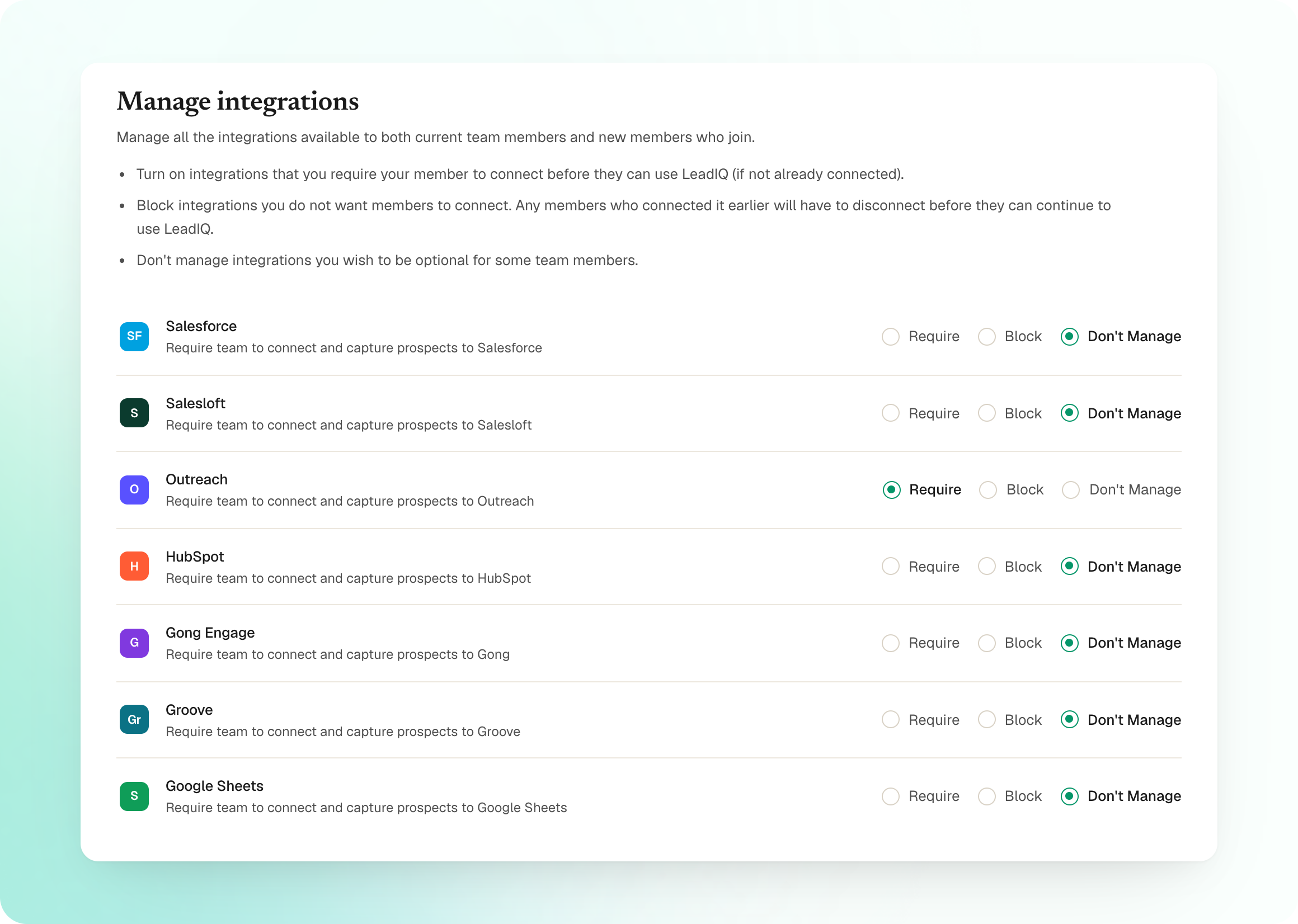
This is exactly the gap LeadIQ's latest release closes. Every email now gets re-verified right before it syncs to Outreach, unless it was already verified within the last 48 hours, in which case LeadIQ skips the redundant check. If the re-verification comes back invalid, the address gets handled the same way LeadIQ's existing re-verification features already work, so a bad email never gets the chance to bounce inside a live sequence.
It's on by default for every organization, managed through Settings > Team > Group Governance settings, and it runs automatically as part of the sync, not as an extra step. Just set it as "required" here and forget about it.
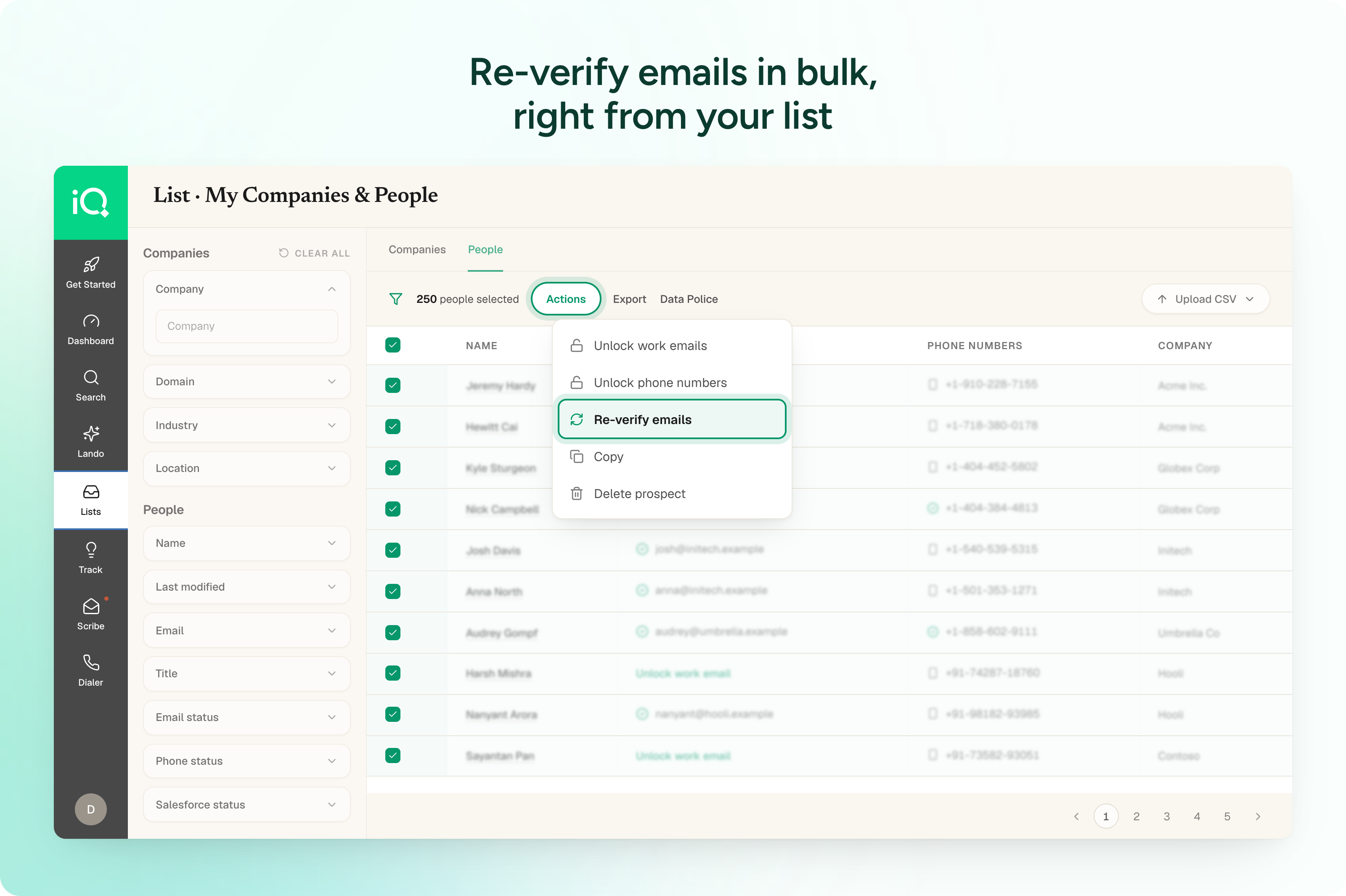
That automatic check covers Outreach syncs specifically. For everything else sitting in a LeadIQ list, on-demand re-verification is available too, and it's not only available to admins. Any user can open the main Lists view, filter by when emails were last checked, and trigger a fresh re-verification pass across every list they have access to, whenever they want a gut check before a big send. Go to the web app > Lists > Actions > Re-verifiy emails.
For teams pushing enriched contacts into Outreach, Salesloft, HubSpot, or Salesforce, this closes one of the more common and least visible sources of bounce: not bad data at capture, but data that went bad while it waited to be used. Combined with regular CRM enrichment to keep the rest of your database current, it addresses both ends of the decay problem, the records sitting in your CRM and the ones about to leave it.
Bounce rate is more than a quality metric. It's a freshness metric, measured at the moment of send, not the moment of capture.
See how automatic re-verification fits into your existing Outreach sync. Book a demo to walk through it.
.png)
.png)