


Table of Contents


No items found.
Ready to create more pipeline?
Get a demo and discover why thousands of SDR and Sales teams trust LeadIQ to help them build pipeline confidently.


AI adoption in sales jumped from 24% to 43% in a single year, and Gartner predicts 90% of B2B purchases will involve AI within three years.
86% of companies saw positive ROI from sales AI in their first year.
Pick one high-friction process like prospecting or lead scoring, deploy AI there, and measure the impact before scaling.
Get a demo and discover why thousands of SDR and Sales teams trust LeadIQ to help them build pipeline confidently.
You're missing deals. Not because your product isn't good. Not because your team isn't trying hard enough. You're missing them because you're still doing sales the way you did three years ago while your competition just deployed AI.
Here's the reality: According to Salesforce's State of Sales report, 83% of AI-enabled sales teams saw revenue growth compared to just 66% of teams without it. That's not a small margin. That's the difference between scaling and staying flat.
But here's what most reps get wrong about AI in sales. They think it's about robots replacing them. It's not. AI in sales is about giving you superpowers you didn't have before, so you can do your job better, faster, and with more precision. The question isn't whether to use AI in sales anymore. It's how to use it strategically.
Let's talk about what that looks like in practice.
The temptation is to apply AI everywhere. Resist that. Start with the biggest pain points on your team. Here are the five highest-impact use cases that most B2B teams should prioritize:
Let's dig into each one.
Your top bottleneck is probably finding good prospects. You spend hours digging through LinkedIn, running searches, checking websites, trying to figure out who's actually a fit. AI changes that equation completely.
AI-powered prospecting tools can scan intent signals, company data, and buyer behavior to surface prospects who are actively in-market and ready to talk. Instead of throwing 500 cold emails at the wall, you're targeting 50 actual prospects who fit your ICP and are showing buying signals. That's the difference between spray-and-pray and precision.
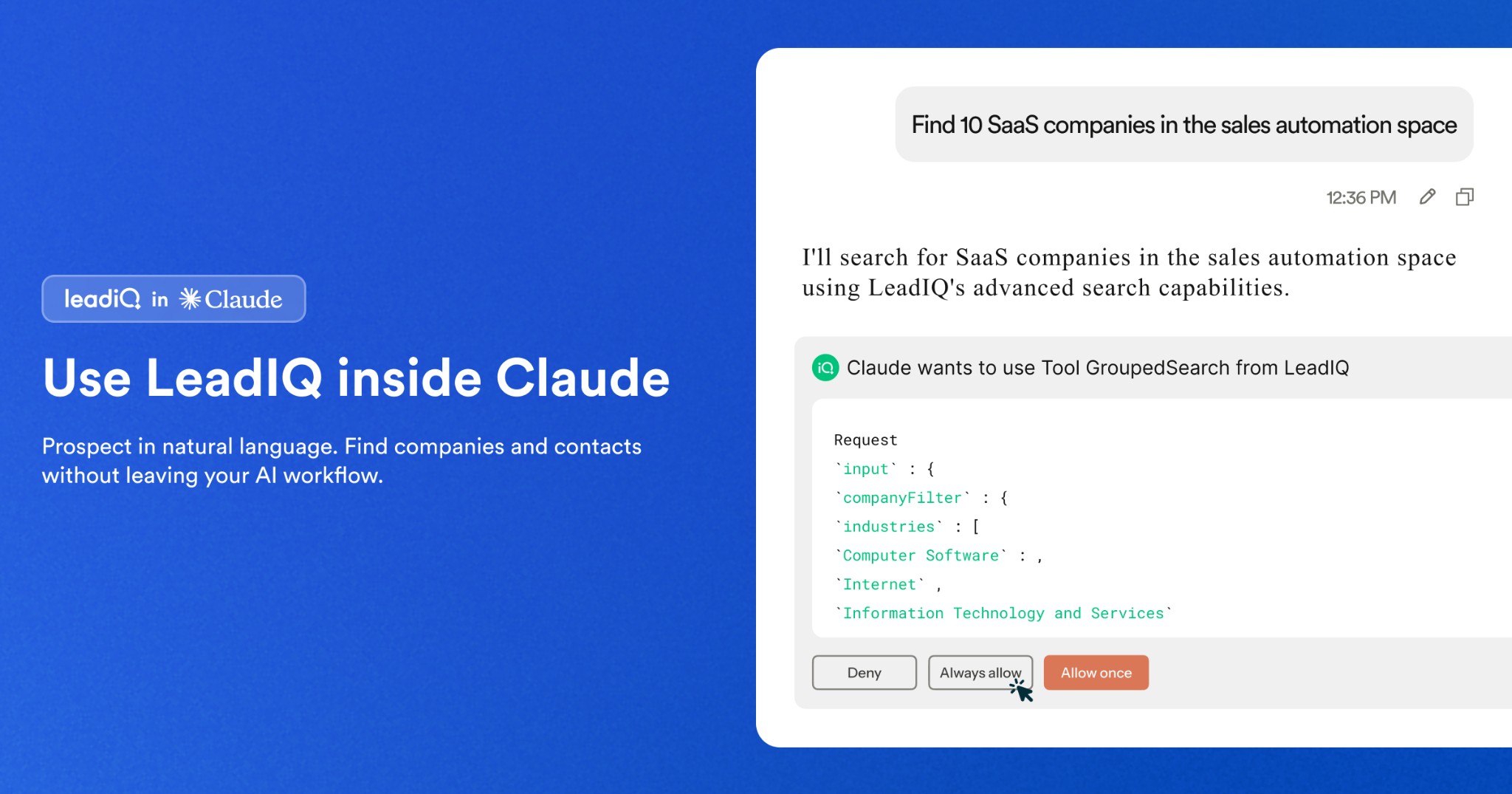
This is evolving faster than most teams realize. LeadIQ recently launched an MCP that connects directly to Claude, so you can prospect in natural language. You describe your ideal buyer, something like "find VP-level contacts at fintech companies with 50-200 employees," and the system pulls matching contacts with enriched data on the spot. Combine that with Salesfinity's MCP, and those verified phone numbers flow straight into your sales dialer for immediate calling.
Here’s a post from our RevOps leader, Juan Ignacio Peñalva, describing the full workflow.
Not all leads are created equal. But manually scoring them takes forever, and your gut feel isn't reliable at scale. This is where predictive analytics for sales comes in. AI can analyze hundreds of data points to predict which leads are most likely to convert and which ones will waste your time.
When you score smarter, your team focuses on the right opportunities. You stop chasing ghosts. You stop having painful conversations with prospects who were never going to buy. Instead, you're having them with people who are ready to move. Gartner research shows that sellers using AI effectively are 3.7x more likely to meet their quotas compared to those who don't use it.
You know what kills open rates? Generic templates that scream "batch and blast." You know what works? Real personalization. But personalizing hundreds of emails manually? That's not scalable.
Natural language processing in sales allows you to generate personalized email bodies based on each prospect's company, role, recent news, and pain points. Not robot-sounding. Real value props tailored to them. HubSpot data shows that 45% of sales professionals now use AI weekly for tasks like this, and there's a reason. It works.
Your forecast is guesswork right now. You're hoping your reps are being honest about their pipeline. You're making business decisions on hunches about whether deals will close. Predictive analytics changes that completely.
AI can analyze your closed deals, win rates, deal velocity, and stage-based metrics to predict which deals in your pipeline will actually close and when. That's not a gut feeling. That's data. Your finance team gets accuracy. Your leadership team stops planning around pessimism or blind optimism. Your pipeline stops being fiction.
Your best rep knows something the other reps don't. Maybe it's how they qualify on discovery calls. Maybe it's how they handle objections. Maybe it's how they build rapport. Whatever it is, that knowledge doesn't scale unless you can bottle it.
AI-powered coaching tools can analyze call recordings and emails to identify what your top performers are doing differently, then surface coaching opportunities for the rest of your team. No more guessing whether someone needs help. You'll know exactly where each rep should improve and what that improvement actually looks like.
Here's what's happening in sales organizations that have embraced AI.
McKinsey research reports that companies implementing AI in sales see 3-15% revenue uplift and 10-20% sales ROI improvements, with some organizations reporting productivity gains worth $0.8-1.2 trillion. That's not theoretical. That's in-market performance.
Sopro's data is even more compelling: 86% of companies saw positive ROI from sales AI in their first year alone. Adoption jumped from 24% of organizations in 2023 to 43% in 2024. That's not a trend anymore. That's the baseline.
Here's the concerning part: if you're not moving on this, your competitor probably is. And they're getting the benefit while you're still running the old playbook.
According to Allego's research, 80% of reps using AI tools report significantly easier access to customer insights, compared to just 54% without. That's a massive gap in decision-making capability. More insight equals faster decisions. Faster decisions equal more closed deals.
One more stat to drive the point home: Gartner predicts that within three years, 90% of B2B purchases will be handled with AI involvement at some stage. This isn't something you should think about next year. Your buying process is changing right now.
You're convinced. Now what? How do you actually implement this without it turning into a failed pilot that becomes a case study in "why we don't do AI"?
Don't try to automate everything. Pick one thing. The process that's eating up the most time and causing the most frustration. For most teams, that's prospecting or lead qualification.
What's wasting your team's time right now? That's your starting point.
Before you add AI, understand what you're actually doing. How are leads being sourced? How are they being qualified? How long does each step take? Where do deals fall out? Document it.
This matters because you need to know where AI fits. Sometimes it replaces a step. Sometimes it accelerates a step. Sometimes it eliminates a step entirely. You can't know without understanding the full picture.
The market is flooded with AI sales tools. Most of them are designed to solve broad problems. You need something that solves your problem. Look for tools that integrate with your existing stack, require minimal training, and actually deliver insights your team will use.
This is where having a platform like LeadIQ's AI-powered prospecting features makes a difference. Rather than bolting together five different tools, you want something purpose-built for B2B sales that understands your workflows.
Deploy with a pilot team first. Measure the output. How much time is being saved? How's the quality of leads changing? How are win rates moving? Use those metrics to build the case for wider rollout.
Most AI implementations fail not because the technology doesn't work. They fail because teams don't measure impact and don't get buy-in from users. Don't let that be you.
Your team will resist this. Not because they're against progress. Because they're busy and change is uncomfortable. Build in training. Celebrate wins early. Show your team that this makes their job easier, not harder. That's how you get adoption.
At its core, AI in sales is pattern recognition at scale. It's taking all the data you already have (emails, calls, outcomes, customer behavior) and using it to make smarter decisions faster.
You can't manually analyze thousands of conversations to find patterns. You can't personally look at every prospect to score them. You can't personalize hundreds of emails in an hour. AI can do all of that while you're in meetings or closing deals.
You don't need a massive initiative. You need one win.
Pick your biggest pain point. Whether it's prospecting, qualification, or forecasting, there's an AI tool that solves it. Get your team one win. Then build from there.
Most B2B sales leaders are still in the early stages of AI adoption. That means right now you've got an advantage if you move. The teams that wait another six months will be playing catch-up.
Start with prospecting. It's the most immediate pain point for most teams. It's the one that frees up the most time. It's the one that directly impacts your pipeline.
LeadIQ's AI data enrichment and AI prospecting features are designed specifically for B2B sales teams like yours, giving you the ability to build smarter prospect lists and focus your outreach on accounts and contacts actually in-market. See how it works with a free account and test it on your next prospecting list.
Here's what's going to happen over the next 12-24 months. Your early competitors are deploying AI right now. They're getting the benefit. They're hitting quotas. They're growing their revenue. Meanwhile, teams that haven't moved yet are working twice as hard to get the same results.
You don't want to be on that second team.
Leveraging AI in sales is a present opportunity. Your team needs tools that help them work smarter. Your pipeline needs visibility that actually predicts outcomes. Your customers need to see you using modern selling techniques.
The question you need to answer: are you going to be the team that leads on AI in sales, or the team that's one step behind?
AI handles the repetitive work that slows down sales teams: prospecting, lead scoring, email personalization, forecasting, and coaching. It analyzes patterns in your data to help reps focus on the right prospects with the right message at the right time.
No. AI handles research, data analysis, and automation. But closing deals still requires human judgment, relationship building, and trust. The best results come from teams that let AI eliminate busywork so reps can spend more time on actual selling.
AI lead scoring uses machine learning to analyze hundreds of data points and predict which leads are most likely to convert. Unlike manual scoring with static rules, AI learns from your actual win patterns and updates scores automatically as new data comes in.
Most teams see meaningful results within 30-60 days of deploying AI for prospecting or lead scoring. The key is starting with one specific problem, measuring the impact, and expanding from there. Teams that try to automate everything at once typically see slower adoption.
Adoption jumped from 24% in 2023 to 43% in 2024, and that number keeps climbing. Gartner predicts 90% of B2B purchases will involve AI at some stage within the next three years. Early adopters are already seeing significant revenue advantages over teams that haven't moved yet.
.png)
.png)
.png)