
Table of Contents


Ready to create more pipeline?
Get a demo and discover why thousands of SDR and Sales teams trust LeadIQ to help them build pipeline confidently.



Sales reps need prospects’ phone numbers to move deals forward and nurture leads across channels.
But there’s a right way and a wrong way to get someone’s phone number — and, once you have the digits, there are restrictions that govern how you can use them.
By learning the various tactics that help you find a phone number and understanding the ins and outs of the TCPA, you can accelerate sales efforts in a compliant manner.
Get a demo and discover why thousands of SDR and Sales teams trust LeadIQ to help them build pipeline confidently.
You need someone’s phone number. Maybe it’s a hot prospect who went dark after your initial email. Maybe it’s an old colleague you’re trying to reconnect with. Maybe it’s a key decision-maker whose gatekeeper is blocking a potential deal.
Whatever the reason, there’s a right way to find a phone number — and a wrong one.
The wrong way? Buying sketchy personal data scraped from the internet, calling numbers without consent, and ending up mired in a $1,500-per-call TCPA lawsuit.
The right way? Using legitimate tools and methods that respect people and privacy laws while giving you numbers that actually work.
If you’re scrambling to find someone’s number, you’re in the right place.
This guide covers both free methods and professional tools you can use to find business phone numbers, the actions you can take once you have them, and how to avoid the compliance landmines that cost businesses millions of dollars each year.
Have you ever heard of the Telephone Consumer Protection Act (TCPA)?
If you’re in sales, you need to know the 1991 law, which governs telemarketing, inside and out. Failing to adhere to TCPA regulations can be costly, with the law carrying statutory damages of between $500 and $1,500 per violation.
Those costs can add up quickly. Just as the robocallers who were hit with a whopping $299,997,000 fine in 2023, the largest penalty ever levied under the TCPA.
Complicating things further, law firms are now finding ways to automate the filing of these claims against companies that violate TCPA regulations (and other privacy laws for that matter). This means that you could easily find yourself facing significant fines even if you’re not aware you’re violating laws in the first place.
To avoid penalties, it’s important to keep these key TCPA provisions in mind:
❌ You can't use autodialers to call cell phones without prior express written consent
❌ You can't call numbers on the National Do-Not-Call Registry for marketing purposes
❌ You can't use prerecorded messages to cell phones without written consent
❌ You can't call residences before 8 a.m. or after 9 p.m. (based on the recipient's time zone)
And in case you’re wondering. . .
The FCC recently confirmed that TCPA applies to all artificial intelligence (AI) technologies that generate human voices or autodial phones. So, if you thought AI would bail you out of this one, you’re out of luck.
The mistake everyone makes: Reps often think TCPA rules only apply to consumers, and not business contacts, but they’re wrong. If you’re calling someone’s cell phone — even if it’s a work cell — TCPA still applies.
Now that we’ve survived the legal fine print, let’s get to the fun part: how to actually find a phone number!
But first: Back when offices were still a place most people worked out of, you could just call a corporate line to find the person you wanted to speak with, maybe even talking to a real human being in the process. But since remote work is all the rage these days, getting a corporate phone number may be even more difficult.
So how can you find someone’s number? Let’s take a look.
LeadIQ offers a free Chrome extension and a free pricing tier you can use to find people’s phone numbers without spending a penny by tapping into our comprehensive contact database.
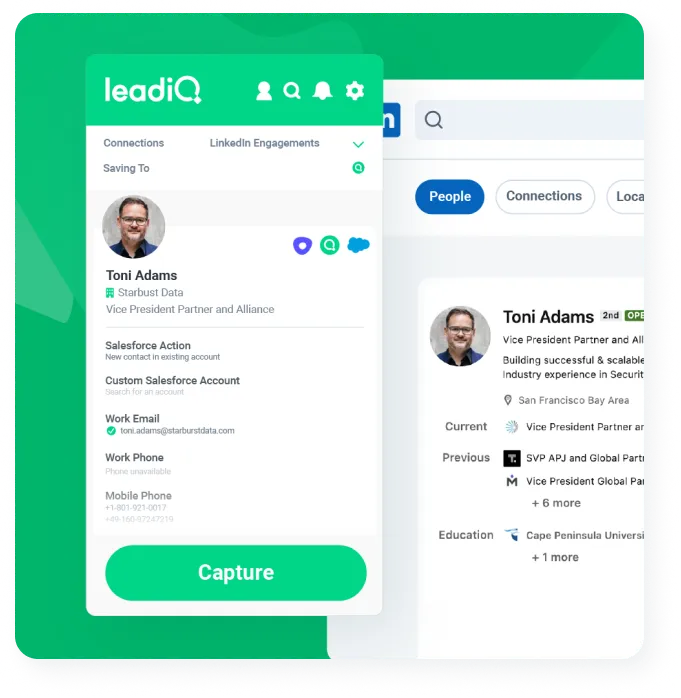
Built to make prospecting a breeze, LeadIQ complies with global privacy regulations on how we collect data. But remember: You’ll still need to make sure that you’re following the TCPA after you get someone’s direct phone number!
Guess what: Some people actually list their real phone numbers right in their LinkedIn profiles. 🤯
Navigate to a prospect’s profile and click Contact info near their profile picture to see whether the person has shared their number with the world. If you strike out, check out their About section; you can occasionally find numbers there.
Still no luck? Consider shooting over a quick InMail asking for their number (this works like 30% of the time if you’ve built rapport).
Limitations: Most professionals don’t publicly list their phone numbers on LinkedIn anymore due to spam. Can you blame them?
Interested in other LinkedIn tips and tricks? Check out this post: How to find someone’s email or phone number on LinkedIn.
Even though it’s not 2010 anymore, you may be able to find a verified phone number on their company’s website. Here’s where to look:
Pro tip: Call the main company number and ask the operator a simple question: “Hello, I’m trying to reach [Name] in [Department]. Do you have their direct line?” You’d be surprised at how often this simple and direct tactic works.
Fancy yourself a Google search engine power user? Try these advanced searches to dig up mobile numbers:
“John Smith” “phone” site:linkedin.com
“Sarah Johnson” “contact” site:crunchbase.com
“VP of Sales” “Acme Corp” “phone number”
inurl:contact “Company Name”
Why this works: Many professionals have their contact info scattered across the web in places like conference speaker bios, press releases, and old blog posts. Search tools can help dig up their digits!
Limitation: This can be a time-consuming process because it’s fully manual, and it’s hit or miss. So you might end up investing a good chunk of time without much to show for it. 🤷
Phone books are no longer a thing. They’ve been replaced by a handful of websites that are still barely legal — and still barely functional — but occasionally have correct phone numbers. These include:
Reality check: These sites are 60% accurate at best, filled with outdated data, and often require paid upgrades for cell numbers. At the same time, people are using services like DeleteMe and Aura to remove themselves from these companies’ databases to increase their online privacy. Unless spending money to violate people’s privacy sounds like your idea of a good time, we’d suggest avoiding them.
On a B2B revenue team that engages in cold outreach? These paid solutions can help you find prospects’ phone numbers.
Features:
How it works:
LeadIQ pricing
You’ve finally found someone’s phone number! Think the hard work is done? Not quite.
Just because you have someone’s number doesn’t mean they’re going to appreciate your call. Are you always thrilled when someone trying to sell you something calls you out of the blue? 🤔
While cold calling comes with the territory for any sales rep, there’s a right way and a wrong way to do it. Here are some tips that’ll help you get it right (and here are even more cold calling tips if you’re interested!).
If you’ve found a mobile number:
To increase the chances your cold call lands, follow this script template, keeping it short, sweet, and to the point:
Hi [Name], this is [Your Name] from [Company]. I noticed you [relevant trigger; posted about X, recently changed roles, etc.]. I wanted to quickly share [specific value prop]. Is this a good time for you?
Not exactly the kind of call you had in mind? We’ve compiled a ton of cold call scripts for every use case to jumpstart your efforts.
If you’ve found a landline or office number:
You’ve got more flexibility here. You can use sales dialers, but you still need to respect time zones (i.e., not calling before 8 a.m. or after 9 p.m. in the recipient’s time zone). You also need to respect DNC preferences. And when you get somebody on the phone, show them professional courtesy (this applies to every conversation, regardless of channel!).
Pro tip: If a prospect asks you where you got their phone number, be honest.
“Relationships are built on trust,” a sales professional wrote on Reddit. “Be transparent and it will pay off in the long run.”
Finding a phone number is easy. Finding the right phone number — and staying TCPA-compliant — is harder. Here are five common mistakes reps make when searching for someone’s phone number, and how to avoid them.
Reps buy sketchy lead lists because it’s fast, cheap, and seems like an easy way to fill the top of the funnel. But the data’s often outdated, inaccurate, and cobbled together through ill-gotten means. Any compliance or consent issues fall squarely on your shoulders.
Why it’s bad: Data is scraped illegally, numbers are recycled and reassigned, no verification of consent
Cost: TCPA lawsuits, wasted time calling the wrong numbers
To hit their quotas, some reps opt to use dialers and AI tools, which promise more calls per hour. But without prior express consent, using these tools is a violation of TCPA, which can lead to lawsuits and financial penalties.
Why it’s bad: Direct TCPA violation without consent
Cost: $500 to $1,500 per call in statutory damages
Thinking the numbers look legit, reps overlook reassigned numbers. But since the original owner’s consent doesn’t transfer to the new owner, calling the wrong person increases complaints and legal risk.
Why it’s bad: About 100,000 phone numbers get reassigned every day in the United States
Risk: You think you’re calling John Smith, but you’re actually calling some random person who just got John’s old number and never consented to your calls
Chasing quotas, calling across time zones, and hustling around the clock, some reps call outside of legal windows — a violation of federal and state laws, which require reps to follow rules based on the recipient’s local timezone. Not only do these violations annoy prospects, they’re also super easy to spot in audits, potentially leading to penalties.
Why it’s bad: TCPA violation, frustrates prospects
Solution: Leverage time zone tools, which are built into most sales dialers
Checking numbers against the DNC is an administrative task that no one likes. It’s easy for it to fall off the bottom of the to-do list. But national and state DNC lists need to be scrubbed regularly; each illegal call can cost you big time.
Cost: Up to $43,792 per call
Solution: Use a DNC compliance service or ensure your data provider already screens all numbers against the DNC Registry
In the real world, most successful sales teams take a hybrid approach to the phone number scavenger hunt, using a combination of the tactics explored in this piece. To mitigate TCPA risk, they also follow a proven workflow that looks something like this:
Why this works:
This four-step prospecting sequence is effective because you establish context before calling while creating implied permission. There’s less TCPA risk here, and it leads to higher connect rates because the prospect might remember your emails and be curious to hear what you have to say.
Top-performing sales orgs run on integrated tech stacks that give reps tools that make prospecting easy. These tools might include:
It’s notoriously hard to find personal phone numbers for the C-suite. They’re rarely listed publicly. (Imagine how many calls they’d get if they were?!)
But there are some tricks you can use to uncover these hidden gems:
Looking for international numbers? Sales intelligence tools like LeadIQ can help. Just make sure they have high-quality coverage before diving in.
Once you find the numbers you need, remember that there are compliance considerations at play here as well. Make sure you understand relevant local laws — the GDPR in Europe, CASL in Canada, and POPI in South Africa, for example.
When you’re ready to make a call, use international calling codes and watch time zones carefully. Just because you might be able to call someone at 11 p.m. or 5 a.m. in another country doesn’t mean you should.
When you’re reconnecting with an old personal contact, different rules apply. Since the situation is less formal — you just want to say hello — more social approaches work.
Try messaging them via Facebook, Instagram, or other social media platforms before calling. You can also tap into mutual connections. Hey, do you have Sarah’s number? I lost it when I switched phones.
Yes, as long as you use public or professional sources. Legality comes into play with how you use it. Follow TCPA rules to avoid fines and other penalties.
You can call a cell phone number for business purposes as long as you dial the number manually and follow TCPA time restrictions. You can only use an autodialer if you have written consent.
Free phone number lookup tools are somewhere between 40 and 60% accurate. Professional tools like LeadIQ and ZoomInfo are 75 to 90% accurate.
Not if it’s a business landline (unless it’s on the DNC Registry). Calling a business cell phone is safer when you have consent or an established relationship.
LeadIQ is more affordable ($15/user/month) than ZoomInfo, making it a better fit for mid-market to enterprise companies looking to capture and enrich contact data. ZoomInfo is a legacy data provider that takes longer to onboard and integrate.
Follow the rules. Manually dial cell phone numbers, scrub DNC lists, call between 8 a.m. and 9 p.m. local time only, maintain opt-out lists, and don’t use autodialers without written consent.
You need written consent to text mobile numbers unless you’re part of a political campaign in the United States. Of course, you can’t text landlines. The safest bet is to avoid cold texting unless you have an explicit opt-in.
.png)

.png)
.png)