
Table of Contents


Ready to create more pipeline?
Get a demo and discover why thousands of SDR and Sales teams trust LeadIQ to help them build pipeline confidently.



AI lead scoring can increase sales velocity by ensuring reps are spending time on the leads most likely to convert.
But that’s only possible when CRM data is high-quality, highly actionable, and cleaned up.
By improving data hygiene, verifying your AI lead scoring model, measuring your progress. and iterating accordingly, you can unlock the full promise of AI lead scoring, closing more deals while making life easier for your reps.
Get a demo and discover why thousands of SDR and Sales teams trust LeadIQ to help them build pipeline confidently.
Talk to any sales enablement vendor about AI lead scoring, and they’ll tell you the same thing.
It’s revolutionary. It’ll automatically identify your best prospects. Conversion rates? They’ll shoot up 30% at least. At least! Your sales team will transform into a lean, mean closing machine. Trust me.
But here’s what they won’t tell you: Most AI lead scoring projects fail within the first year. Not because the technology doesn’t work, but because companies are so eager to roll out AI lead scoring that they do it before they get their data house in order by fixing their spreadsheets first.
Chasing the brand-new shiny object, these companies ignore the fact that their CRM is filled with duplicate records, their “ideal customer profile” is anyone with a pulse and a credit card, and their sales team doesn’t even follow-up on the high-quality leads they already have, at least not with any sense of urgency.
This article takes a different approach.
Instead of trying to sell you on the promise of predictive lead scoring, we’re going to tell you exactly how it works, the reasons why it fails, and the (unfortunately) unglamorous work you need to do before forking over six figures on a predictive scoring platform.
AI-powered lead scoring is the process of using machine learning models trained on historical conversion data to surface high-quality leads.
Unlike traditional lead scoring, AI lead scoring incorporates far more data and more advanced analytics to connect the dots most humans might not see.
While traditional lead scoring models are built on static, rule-based criteria, AI lead scoring tools analyze hundreds of signals and continuously adjust scores in real time as buyer behavior changes. When implemented correctly, they become a key piece in any sales automation strategy.
There’s a reason the global AI lead scoring market jumped to $1.2 billion in 2024 and is expected to reach $7.8 billion by 2033: the technology, when implemented properly, delivers substantial benefits.
With the right approach, AI lead scoring helps sales teams focus on leads that are 2-3x more likely to close, making it much easier to hit their quotas. This laser-focus reduces wasted sales time by anywhere between 40% and 70% — a big deal, since the average salesperson already spends less than 30% of their week actually selling.
At the same time, the tech also speeds up sales cycles since reps engage high-intent leads at optimal moments. When implemented properly, AI lead scoring helps you build a much more efficient sales engine.
A centralized AI lead scoring tool increases alignment between sales and marketing teams. With an automated, shared scoring system, the classic “your leads suck” arguments are eliminated.
Rather than scoring leads based on opinions, the tech gives teams clear handoff criteria based on data. As a result, marketing and sales teams work together fluidly using the same conversion model.
AI lead scoring helps GTM teams significantly improve pipeline forecasting accuracy, which enables them to allocate resources more effectively. It also identifies which marketing channels produce the best leads, ensuring every marketing dollar invested delivers maximum impact.
Due to their manual nature, traditional lead scoring models are difficult to update. With AI lead scoring, on the other hand, models adapt to market changes automatically. Seasonal patterns, product launches, and pricing changes are all reflected in scoring, with zero manual intervention required.
Do you have a current lead scoring system in place? If you’re using a vendor, do you understand how their traditional lead scoring model works? Do you have enough customers where statistically significant data analysis can be performed to identify patterns?
If your answer is no to any of these questions, you probably aren’t ready for an AI-powered lead scoring system.
To help you figure out where your team currently stands, here’s a quick guide that should point you in the right direction.
✅ At least 500 leads per month
✅ At least 12 months of clean historical data with clear won/lost outcomes
✅ Multiple buyer personas with complex, multi-touch journeys
✅ CRM hygiene above 80% (no duplicates, complete fields)
✅ A sales team that actually follows up on marketing-qualified leads (MQLs) within 24 hours
✅ Budget for proper implementation ($50,000 to $150,000 depending on scale)
❌ Fewer than 500 qualified leads per quarter
❌ A "CRM" that’s still partly in spreadsheets or scattered across multiple tools
❌ An ICP you can’t define beyond industry or company size
❌ A sales team that ignores most marketing-generated leads
❌ A conversion timeline that’s 12+ months (not enough data velocity)
❌ Not optimized your basic follow-up processes
Even if all the above criteria tells you that you’re ready for AI lead scoring, there’s still a chance you might fail when implementing it.
We’re not here to scare you. We just want to make sure you fully understand what pitfalls could happen so that you can avoid them.
AI models learn from historical patterns. If your past data is garbage, the model will predict garbage. For example, a company might discover their “high-converting leads” are actually all from one sales rep who incorrectly marked lost deals as won.
“When your CRM is clean and updated, AI can rank leads with good accuracy and save hours of manual sorting,” one Reddit user recently wrote. “The problems start when the data is thin or messy. Missing details, outdated info, or low volume can make the model score leads incorrectly.”
The fix: Conduct a data audit before implementation, not after.
Have you seen the gossip on LinkedIn about companies churning from 6sense and Demandbase?
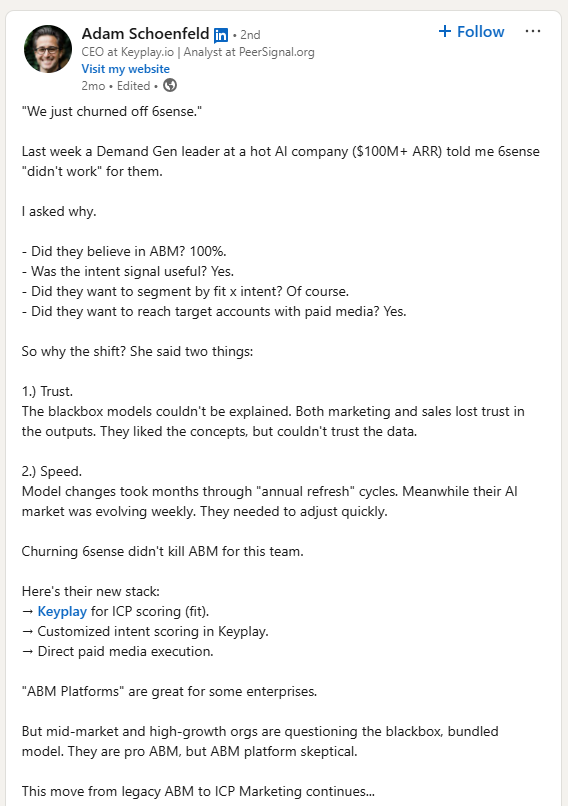
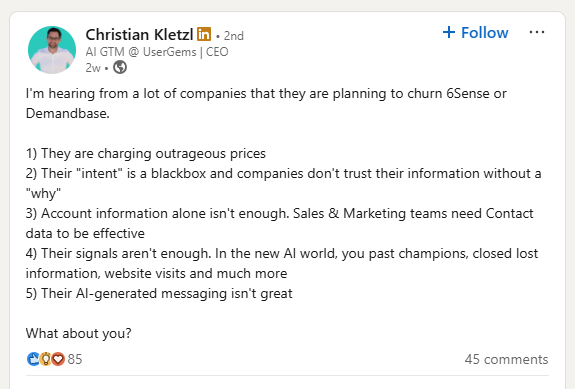
Just a few years ago, these companies were dominating account-based marketing with their proprietary lead scoring models. Today, teams no longer trust these scores because they have no idea how they’re calculated. With the hefty price tag of these solutions, competitors are popping up — and customers are churning.
It turns out sales teams won’t trust scores they don’t understand.
But “the AI says this is a hot lead” doesn’t fly when it contradicts a rep’s instincts. Without explainability, you get resistance and workarounds — effectively the opposite of sales enablement.
The fix: Demand transparent scoring with reason codes from AI lead scoring vendors. The right tool will clearly explain the reasoning behind each score (e.g., “This lead has a high score because they visited the pricing page, they work for an enterprise that matches our ICP, and they have a decision-maker job title”).
AI scores don’t mean anything if they don’t trigger workflows. Scores sitting in a separate platform that nobody checks are essentially expensive dashboard art — even if they’re the most accurate scores on the planet.
The fix: Before you implement AI lead scoring, make sure real-time CRM integration and automated routing capabilities are properly configured.
Companies that adopt AI-driven lead scoring can boost conversions and accelerate sales pipelines. Unfortunately, you can’t just plug in an AI lead scoring solution and expect jaw-dropping results. You need clean data, a model you trust, and a tool that plays nicely with everything else in your sales tech stack.
Follow this structured framework to increase the chances your AI lead scoring initiative is a smashing success.
Before you touch AI, you need to lay a proper foundation. Start by auditing your data quality, with a goal of at least 80% completeness and accuracy. Next, define your ICP with actual specificity (think: not “enterprise companies” but “enterprise fintech companies based in the United States with at least 10,000 employees”).
Once you’ve checked those boxes, document your current lead qualification criteria — like BANT, MEDDICC, or FAINT. Wrap up phase one by getting actual buy-in from sales leadership, not just just vendors pitching them.
Once you’ve built a solid foundation, choose a single use case — yes, just one. Maybe you want to optimize inbound lead routing or maybe you want to streamline outbound account prioritization, for example. Whatever bucket you opt for, select 20% to 30% of leads for AI scoring, leaving the rest in the control group.
Run your AI lead scoring tool in parallel to your existing process to verify its effectiveness. Measure metrics like conversion rates, time-to-close, and sales satisfaction to figure out whether the AI-scored leads outperform your control group.
After you’ve built positive momentum, review model explanations with your sales team. Adjust scoring thresholds based on outcomes, like which leads converted after effective lead nurturing and which high-scored leads stalled despite strong outreach. If any integration gaps exist, address them immediately. At this stage, document what’s working and what isn’t, and adjust any knobs you can to fine-tune your workflows.
Did your pilot succeed? Awesome. Expand the program to 100% of leads and start thinking about additional use cases you might explore — like reactivation, upsell scoring, and churn prediction.
Keep in mind that your AI lead scoring initiative is never set in stone. Establish an ongoing model monitoring cadence to review impact and make any appropriate adjustments. Keep your team in the loop with quarterly retraining sessions to ensure everyone stays on the top of their game.
Now that you know the ins and outs of AI lead scoring and how to successfully incorporate it into your sales workflows, it’s time to figure out which platform makes the most sense for your organization.
To do that, you first need to determine whether you prefer a native or third-party solution.
If your company uses Salesforce or HubSpot as its CRM, it can make a whole lot of sense to leverage their AI lead scoring tools — you might already be paying for them anyway. After all, your customer data already lives inside these platforms. But on the flipside, you’re pretty much working with whatever the vendor offers you; customization is limited.
Not sold on the rigid tools HubSpot and Salesforce offer? It’s worth exploring third-party options, like 6sense, MadKudu, Leadspace, and Warmly, each of which are more sophisticated. But if you move in this direction, don’t forget how important integrations are, and consider costs, too.
Here’s another quick checklist to consider as you whittle down your options.
✅ Model explainability (reason codes for scores)
✅ Real-time score updates
✅ Custom model training on your data
✅ Multi-channel signal integration
✅ API access for custom workflows
✅ A/B testing capabilities
✅ Regular model retraining (at least monthly)
🚩 "Our artificial intelligence works out of the box with no data"
🚩 Can't explain how scores are calculated
🚩 No way to provide feedback to improve the model
🚩 Requires proprietary data fields that lock you in
🚩 Implementation timeline under two weeks (impossible to do right)
The only way to be certain that your investments in AI tools are worthwhile is by measuring its impact on revenue and sales efficiency.
Tracking the right metrics helps you validate the lead scoring model and uncover any blind spots that might exist. To ensure AI is prioritizing the right leads and leading you to strong business outcomes, here are some key performance indicators (KPIs) to track.
📉 Lead response time, which measures how fast reps engage leads, should decrease.
📈 MQL-to-SQL conversion rate should increase as AI surfaces higher-intent leads.
📈 Sales rep satisfaction with lead quality (survey-based) should increase as reps receive better-qualified leads and spend their time focusing on high-intent prospects.
📈 Win rate on AI-scored leads vs. control group should increase as prioritization improves.
📈 Average deal size by score band should increase as reps target high-quality prospects.
📉 Sales cycle length by score band should decrease for the same reason.
📉 Cost per acquisition should decrease as sales efficiency improves.
🤖 Before: What percent of your top score band actually converts?
🤖 After: That number should increase by 30% to 50% if the model is working.
AI lead scoring has the potential to transform the way your team sells, making it easier to hit quota with a lot less headaches while also helping your sales org better predict revenue.
But AI lead scoring isn’t just a plug-and-play technology. Getting it right requires having highly actionable, high-quality data and clearly defined buyer personas. You also need a team that’s eager to quickly pounce on any high-quality lead that falls into their laps — and, of course, a budget for proper implementation.
And keep in mind that what we’ve discussed in this piece is just where things stand right now.
As we move further into the age of agentic AI, that’s when things get really interesting. Imagine AI agents that never sleep, scoring each website visit, analyzing call transcripts and email tone, and factoring in unstructured data — like product reviews and forum posts — into their scores.
In the future, we won’t just use AI lead scoring to understand whether a prospect will buy. We’ll use it to figure out how much they’ll spend over five years.
All that said, AI is not a panacea. Don’t use it to fix your broken processes. Instead, use it to amplify and accelerate what’s already working.
If your CRM is a mess, your ICP is vague, and your sales team doesn’t follow up quickly anyway, save your money and fix those problems first. They’re cheaper to solve and will have a much bigger impact.
But if your team is disciplined, data-driven, and ready to commit to a smooth implementation, AI lead scoring can absolutely be transformative. It just won’t be easy, fast, or cheap.
Ultimately, the success of your AI lead scoring initiative starts with high-quality contact data — which is our bread and butter here at LeadIQ. Not only do we pride ourselves on exceptionally accurate and robust contact data, our AI-powered data enrichment capabilities ensure that data stays up to date, always.
This is part of the reason why we were recognized with 28 new G2 badges for Winter 2026, including:
To learn more about how LeadIQ can set your team up for AI lead scoring success, request a demo today.
At least 500 converted leads with complete records, but ideally more than 1,000. If you don’t have that much data to play with, consider starting with rule-based scoring and accumulating data.
It takes an average of six months to implement and begin scaling an AI lead scoring initiative. Pilot results should wrap up within three months or so, and then you’ll want to spend the next three months fine-tuning your program before rolling it out across your entire sales org.
Lead scoring can deliver significant gains for small businesses, especially those with high lead volumes and limited sales resources. With the right approach, AI lead scoring acts like a force multiplier — helping small teams punch above their weight.
While SMBs might not have enough historical data to build a truly custom model, they can take a hybrid approach, combining their internal data with industry partners to get a better picture of what their ideal customer looks like.
Long sales cycles make it harder to unlock the full potential of AI lead scoring, but it can still work effectively using those leading indicators we just talked about.
With the right tools, AI can score intent signals long before a deal closes, giving you a better idea of the impact your tool is delivering. Great at pattern recognition, AI can help uncover patterns humans might struggle to see in deals that stretch on for a year or longer — giving you a good idea of how your program is performing.
.png)

.png)
.png)