Table of Contents


Ready to create more pipeline?
Get a demo and discover why thousands of SDR and Sales teams trust LeadIQ to help them build pipeline confidently.


.png)

Apollo's actual costs run 60-80% higher than listed prices due to credit overages and mobile number reveals at 8 credits each.
The right alternative depends on your pain point: LeadIQ for workflow speed, Cognism for European data, ZoomInfo for enterprise ABM, Lusha for budget teams.
Data accuracy matters more than database size when calculating true cost per usable contact.
Get a demo and discover why thousands of SDR and Sales teams trust LeadIQ to help them build pipeline confidently.
Apollo.io has over 9,000 G2 reviews and a 4.7-star rating. On paper, it looks like the obvious choice for sales prospecting. But ratings don't tell you what happens after month three.
That's when the credit overages start hitting. When your bounce rates creep past 15%. When your reps realize that eight credits for a single phone number adds up fast, and half those numbers don't even connect.
According to a data accuracy analysis by Autoposting.ai, Apollo's actual data accuracy sits around 65-70%, well below what most teams expect when they sign up. If you're running outbound at scale, that gap between advertised and actual accuracy costs you real pipeline. So what are the actual options?
The complaints tend to follow a pattern.
Teams sign up for Apollo's Basic plan at $49/user/month, thinking they're getting a clean prospecting tool at a fair price. Then reality sets in.
The credit system is the first surprise. Email reveals cost one credit each, but mobile numbers cost eight. According to a review analysis by SalesForge, teams regularly see their actual spend hit 60-80% above the original subscription cost once credit overages kick in. And credits don't roll over. Use them or lose them.
Email deliverability is the second problem. A NexuScale analysis found that Apollo users often see inbox placement rates start around 65% in month one and drop to 23% by month six. The volume-based approach triggers spam filters, and shared IP reputation issues compound over time.
Then there's the international data gap. Apollo's coverage outside North America is spotty at best. If your team sells into Europe or APAC, you're working with incomplete records and outdated titles.
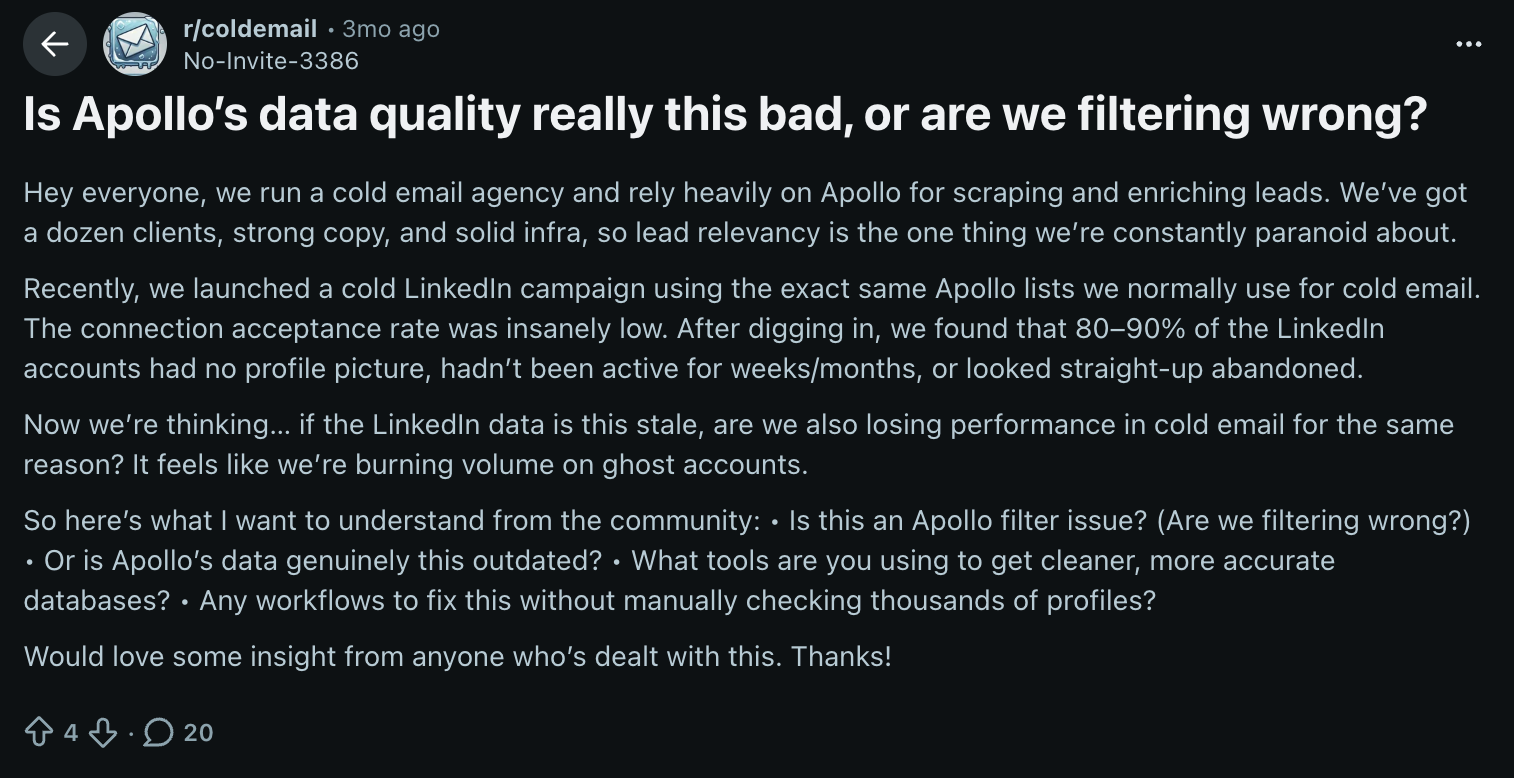
The frustration isn't just showing up in review sites. Sales communities on Reddit are full of threads asking whether Apollo's data quality has gotten worse. Users report "verified" emails bouncing at 25-35%, credits burning faster than expected, and phone numbers that ring dead lines. One recurring theme: teams that relied on Apollo for cold email are now running every list through third-party verification tools just to avoid domain damage.
None of this means Apollo is a bad tool. For early-stage teams doing low-volume outbound in the US, it works fine. But once you need reliable data at scale, most teams start looking for apollo.io alternatives that prioritize accuracy over volume.
The good news? There are plenty of solid options.
LeadIQ isn't just a prospecting tool. It's a unified data platform that plugs into however your team actually works.
Most apollo.io alternatives give you a database and a search bar. LeadIQ gives you verified contact data inside the workflows your team already uses. SDRs prospect directly alongside LinkedIn with a one-click Chrome extension. AI-powered reps can pull LeadIQ data through Claude and other AI assistants. Cold callers pair it with Salesfinity for parallel dialing. The platform adapts to your team's motion instead of forcing everyone into the same workflow.
That ecosystem flexibility is what makes LeadIQ different. Sales teams use it for prospecting and outreach. RevOps teams use it to keep CRM records clean through automated data enrichment. Marketing teams use it to build targeted account lists and validate campaign segments. One platform, three different use cases, all pulling from the same verified data layer and the same credit pool.
Scribe, LeadIQ's AI writing assistant, pulls context from the prospect's profile, company news, and recent activity to generate personalized messages. Your reps aren't just getting data, they're getting ready-to-send outreach tailored to each contact.
You can create a free account that comes with 50 free credits per user. Pricing starts at $15/user/month. No confusing credit multipliers for different data types.
Are you tired of paying eight credits for a phone number that doesn't connect?
LeadIQ's verification process catches bad numbers before they reach your reps. For teams evaluating apollo.io alternatives, that kind of quality control changes the ROI math entirely. And because the data flows into Salesforce, HubSpot, Outreach, Salesloft, and dozens of other tools natively, there's no manual export step slowing things down.
ZoomInfo is the enterprise heavyweight. With 260 million individual profiles and 135 million verified mobile numbers, it has the largest B2B database on the market. According to Juicebox's pricing analysis, plans start at $14,995/year for Professional and go up to $39,995/year for Elite.
The platform processes over one billion buying signals monthly, which makes it powerful for account-based strategies. But that power comes with complexity and cost that smaller teams can't justify.
ZoomInfo's European coverage is also limited. ZoomInfo has roughly 39.5 million European contacts compared to Cognism's 200 million. If your ICP includes EMEA accounts, that's a significant gap.
Cognism owns European B2B data. With 200 million European contacts and a 16-step email verification process, it's a good choice for teams selling into EMEA markets. Cognism is also fully GDPR-compliant, which matters more every year as privacy regulations tighten.
The phone-verified mobile data is Cognism's real differentiator. Instead of scraping numbers from public sources, they verify direct dials through an actual calling process. Pricing is custom, so you'll need to talk to sales.
Lusha keeps things simple and affordable. Plans range from free to $79/month, and the platform focuses on core prospecting without trying to be an all-in-one sales suite. Lusha holds a 4.3/5 rating on G2 from over 1,400 reviews, with users consistently praising its ease of use.
For solo reps or small teams that need verified emails and phone numbers without the complexity of a full platform, Lusha delivers. It won't replace your CRM or your sequencing tool, but that's kind of the point.
Seamless.AI differentiates through real-time verification. Rather than maintaining a static database, it uses AI to verify contact data at the moment you request it. The platform also tracks job changes in real time, which makes it useful for teams that sell into accounts with high turnover.
Pricing requires a sales conversation, which some teams find frustrating. But the real-time approach does produce fresher data than most static databases.
RocketReach claims the largest database at 700 million profiles. The platform offers 100+ search filters and works well for both recruiting and sales use cases. Pricing runs from $49 to $299/month depending on credit volume.
The breadth is impressive, but breadth doesn't always equal accuracy.
RocketReach works best as a supplementary source when your primary tool comes up empty on specific contacts.
Hunter.io is an email specialist. It doesn't try to be a full sales intelligence platform. Instead, it finds and verifies email addresses with claimed bounce rates under 2%. Plans range from free (25 searches/month) to $199/month (10,000 searches).
If email is your primary outreach channel and you don't need phone numbers or company intelligence, Hunter.io delivers clean data at a fraction of what full-platform tools cost.
The right tool depends on what went wrong with Apollo for you. Here's how the major alternatives stack up:
What's your biggest pain point with Apollo? If it's credit costs and workflow friction, LeadIQ solves both. If it's European coverage, LeadIQ wins with 63%.
Don't just swap one tool for another without fixing the underlying problem. Here's what actually matters when you're evaluating contact data providers.
Data accuracy over database size. A tool with 100 million verified contacts beats one with 700 million unverified ones. Ask every vendor for their actual bounce rate data, not their marketing claims.
Transparent pricing. If you can't calculate your annual cost within five minutes of looking at the pricing page, that's a red flag. Watch for credit multipliers, usage caps, and features locked behind higher tiers.
CRM integration depth. Capturing data is only half the job. The tool needs to push clean records into your CRM without creating duplicates or overwriting existing fields. Test the integration before you commit.
Workflow fit. Where do your reps actually spend their time? If they live in LinkedIn, a tool with native LinkedIn integration saves more time than one with a slightly larger database. If they're running sequences from HubSpot, CRM-native enrichment matters more than a standalone platform.
How many hours per week do your reps spend cleaning bad data?
That's the real cost of cheap contact data. And it's the main reason teams search for Apollo.io alternatives in the first place.
The sales intelligence market hit $4.85 billion in 2025 and is growing at 11.3% annually. There's no shortage of options. The challenge is finding the tool that matches your team's actual workflow instead of forcing your team to adapt to the tool.
LeadIQ was built as a unified data platform that works across your entire go-to-market team. SDRs prospect from LinkedIn and Claude. Cold callers dial through Salesfinity. RevOps keeps the CRM clean with automated enrichment. Marketing builds targeted lists. All from the same verified data layer, no credit math, no database diving.
Try LeadIQ free for 30 days and see the difference clean B2B data makes in your outbound pipeline.
What is the best free alternative to apollo.io? LeadIQ offers a free plan with 50 free credits that you can use to uncover either verified emails or phone numbers. Hunter.io also has a free tier with 25 email searches. For teams just getting started with outbound, either option works without a credit card.
Why are teams leaving apollo.io? The most common reasons are data accuracy issues (actual accuracy around 65-70%), confusing credit costs that exceed the advertised subscription price, high email bounce rates that damage sender reputation, and limited international data coverage.
Is ZoomInfo better than apollo.io? ZoomInfo has a significantly larger and more accurate database, but costs 10-20x more. Apollo is more affordable but struggles with data accuracy and hidden credit costs. LeadIQ gives you the best of both worlds: verified data quality comparable to ZoomInfo's standards at a price point closer to Apollo's, starting at $15/user/month. Plus it works as a unified platform across sales, RevOps, and marketing instead of locking you into a single workflow.
How much does apollo.io actually cost? Apollo's listed prices range from $49 to $119/user/month (annual billing). But real-world costs are typically 60-80% higher due to credit overages, especially for mobile number reveals at 8 credits each. Teams should budget for $80-$200/user/month in actual spend.
Can I use multiple sales intelligence tools together? Yes, and many teams do. A common approach is pairing a primary tool like LeadIQ for daily prospecting with a supplementary source like RocketReach or Hunter.io for contacts your primary tool can't find. The key is making sure your data enrichment workflow doesn't create duplicates in your CRM.
.png)

.png)